
Palladium Leaf & 23.5 K Double Thick English Gold Leaf
 |
 |
 |
 |
 |
...."to gild or not to gild, that is the question"
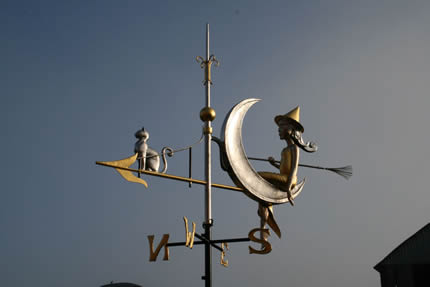
GOLD:
Gold Leaf or Palladium Leaf can be applied to all or part of any commissioned weathervane. Whether it's a touch of gold on the cardinal letters, or an entirely gilt design, areas for gold can be pre-planned or decided when the vane is fully assembled and complete....
With ungilded copper weathervanes, repousse (chiselled/hammered) details and texture naturally shine out. The movement and shifts of the piece itself, highlight moments of beauty and craftmanship. Intentional bold piercings and dynamic negative spaces let the sky, wind, and sunlight "do the talking". Depite this, full gilding is the traditional finish for copper weathervanes. In lowlight settings (moonlight, late afternoon sun, or moody weather) gold truly comes into it's own. It brings a honey-warmth and austerity unmatched by any other material finish and, in diffused interior light or paired in backdrops of stone or brick, it can be a remarkable tonal juxtaposition & celebration of this non-reactive metal's jewel-like qualities.
THE OUTCOMES WITH GOLD:

HEBRIDIAN LYMPHAD
Isle of Mull, Scotland

HARRIER HAWK
Derbyshire, England

KESTREL
Essex, England
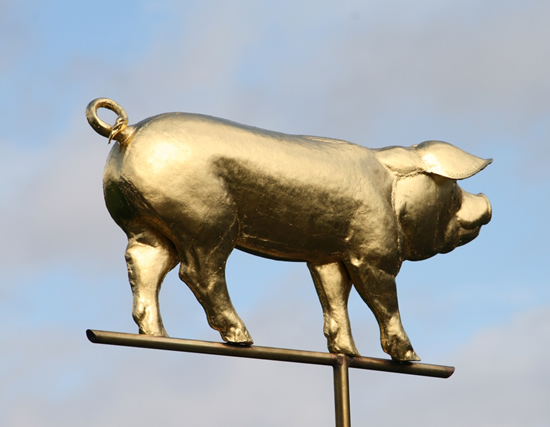
PIGLET
London, England
From a distance, a fully or partially gilded vane, with a backdrop of sky, shines out it's own personality, hallmarking the building, and acting as a beacon calling from distant views
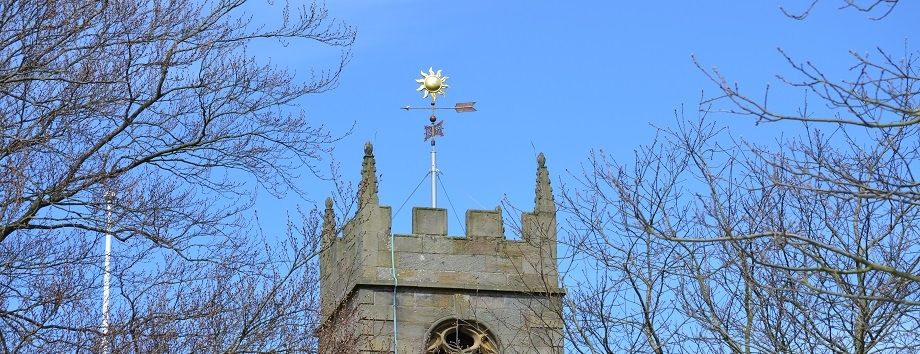
"1639"
Commemoration of Jeremiah Horrocks
Chesire, England
....
GILDED LETTERING & SPUN COPPER BALLS:
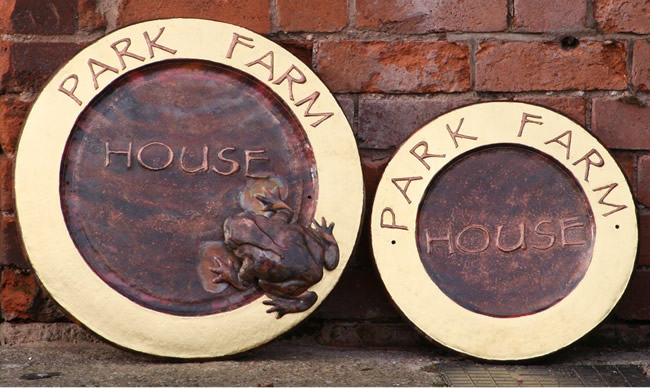
Gold leafing usually extends a commissioned project schedule by 2-3 weeks, and also needs time to cure. Gilded lettering (i.e. house names, dates or intials) takes particular care and attention: how the letters or numbers are raised in copper, has impacts on legibility in gold, so best discussed at the outset.
Often times gold is a moment to be playful, bold and creative. Sometimes it's the subltest of nods that is necessary (cat's whiskers or a single star). Predominantly gold behaves best when it is given a large singular area to describe, rather than a rhythm of isolated parts. Although counter-intuitive, doing the background of words inscribed, can be more effective than gilding the letters themselves. Spun copper balls are by far the most popular in the gilded genre, creating a balanced visual pause between roof and vane, or NESW letters and motif. Clients have options to combine gold and palladium leaf as well. From experience, this leafing combination is best "described" when paired with a matte-black paint.

TWO BLACKBIRDS
Northhamptonshire, England
....browse the portfolio to view
more designs
still undecided about gold
TWO BLACKBIRDS (befor gilding)
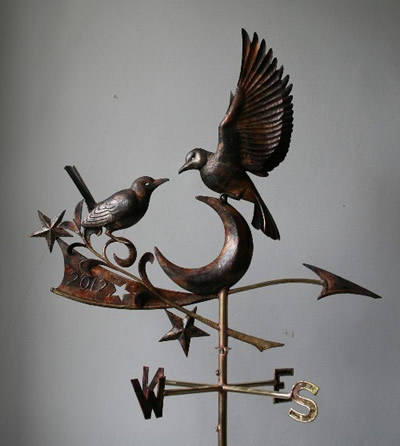
In exterior architectural application, copper is most prized for being non-corrosive (unlike steel or iron), losing no material integrity or thickness over time, and requiring no maintenance or protection. It is also the most compatible base metal for gilding. Historically, weathervanes seated atop noteworthy buildings were designed to be highly-visible statement pieces and therefore necessarily gilded. However, without gold, the copper is no less eye-catching or desirable. Ultimately it is the function and the motif, that draw the eye, and the designers job to make sure this happens.
The general timeline for bare copper to start to patinate is 5-30 years, but often more. Therefore, the true verde-gris journey happens usually outside of the watchful eye or our lifetimes. The first stage for most vanes, is a uniform but slow darkening of the metal, almost to black. Eventually a gradual and very light haze of "minted" green sets in. This appears initially in crevices were rainwater collects, depositing minerals as it dries. Gold is non-reactive so there is no change in colour or lustre, but it will remain in conversation with the material colour adjacent to it, so appears to tonally shift as the copper patinates. Ultimately, windblown particles will slowly erode the material leaf (our supplier suggesting timeframes of 20-30 years) starting in areas most raised and exposed.
Verde-gris (alternatively, verdigris) literally translates as the "green of Greece", giving some insight into why it is desired. Despite weathered-copper being sought after by collectors, and a treat to see on the skyline, it is the gilded copper vane, with only trace-gold still visible, that is considered the pinnacle example of where an aged material application (rather than the material itself) enhances antique value.
So, when choosing between gold or "just" copper, it is sometimes
"next-generation" we are considering...and sometimes it
is what will look fun and punchy right now. And sometimes it is to
raise a design to the next level. Either way both material finishes
give options for play and we are happy to share previous projects
for inspiration.
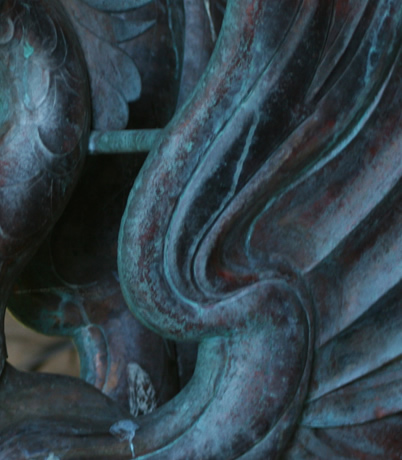
Copper Patina
verde-gris establishing
Brighton, England
Contact
us to discuss
your gilding project
About Gold Leaf:
|
Greens Weathervanes use 23.5 K double thick English Gold Leaf. The sheets of loose leaf gold are applied to the copper's surface using a squirrel hair gilder's tip. The copper's surface is first prepared by cleaning, priming, and sizing using a 12 hour oil-based size. It is the sizing which, when tacky, bonds the gold to the copper. Finally the gold is burnished and allowed to cure before shipping is possible. The manufacturer recommends regilding after 20-30 years outdoors. |
Periodic symbol: Au Atomic number: 79 Melting Point: 1064.43°C |
 1.27x10^-5cm
thick Evidence suggests ornaments in gold dating back over 5,000 years. The Egyptians, however, were the first gilders: expanding the use of gold's malleability, ductility and non-reactivity into the realm of "leafing". Stone-beaten ingots were carefully "forged" down to foil on flat metal tablets masked with hides or other soft materials. Master gilders were able to then take advantage of the tranformative powers of this mirror-finish "leaf" , applying it to wood, metal, plaster, stone and even paparys. Since this material-use breakthough, modern metal-hammering techniques have allowed for a more manageable thickness closer to 1/300,000th of an inch thick. This paired with a squirrel-hair gilder's tip, allows the blow-away sheets to be applied with a seasoned and steady hand. Aside from these small shifts, production methods of the loose-leaves themselves is largely unchanged. |
GREENS Weathervanesbeautifully bespoke copper weathervanes England since 1995


home | about | weathervanes
| sculpture | new!
| available now | contact
purchasing | installation
| gold leaf | exhibitions
| the artists |
history
| visit